This article contains references to substance misuse and suicide. If you are struggling, Samaritans are available 24 hours a day on 116 123.
Nicola Patterson was 11 when she had her first drink. It was in Darlington, where she and her friends would head to the park and wait outside the shop for somebody old enough to buy them Lambrini. By the time she reached college, drinking had become more important than going to lessons. She was eventually thrown out.
As she got older, alcohol gave way to drugs. What had started as teenage experimentation became a way of life that followed her into adulthood. She spent a year in Australia, mostly drunk by her own account, before moving to Vietnam to teach English. Living somewhere different gave her a wider perspective on the world and, more importantly, on the small social circles she’d become accustomed to at home.
“I think you can get stuck a little bit in a small town, especially when you’re hanging about with the same kind of people. Everyone was drinking and doing drugs.”
Her own account is more complicated than that. She talks about bullying, feeling like a loner, being unsure of where she fitted in, and eventually finding herself surrounded by people living in much the same way she was. Today, she is still in Darlington. The life looks very different.
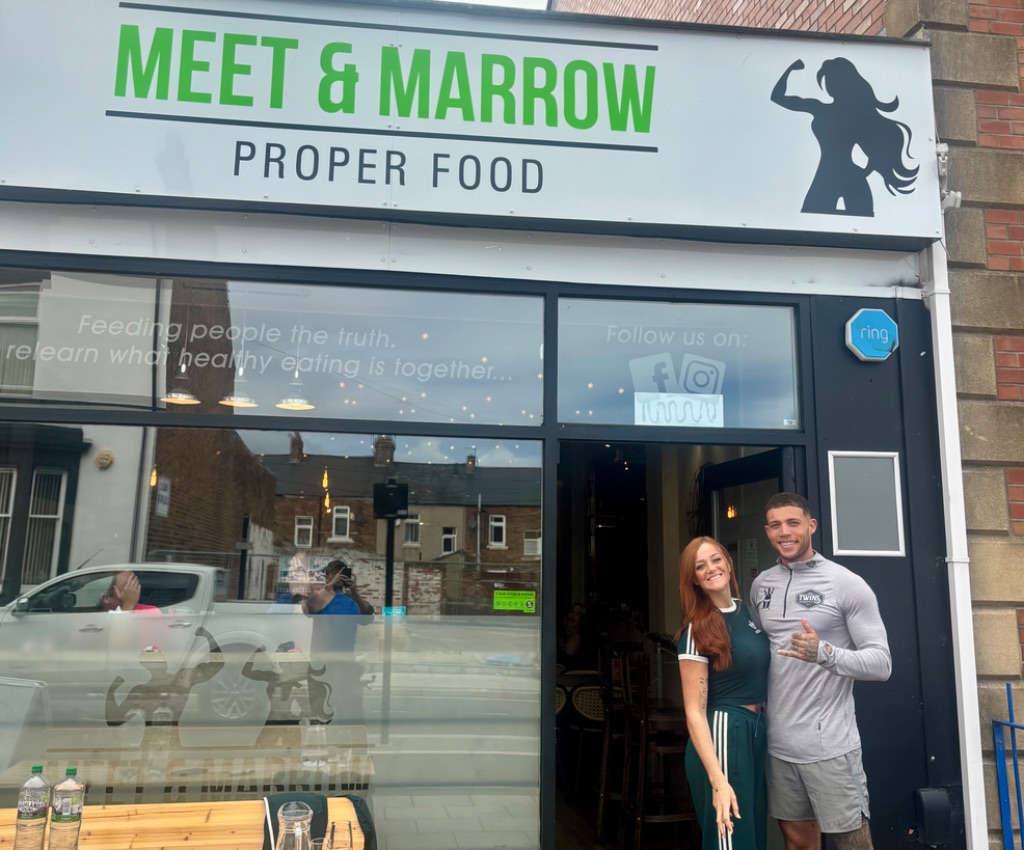
Nicola & Axel
Nicola now runs Meet & Marrow on Duke Street with Axel Tucker, a childhood friend she met through the same social world they would both eventually decide to leave. It is a luncheonette built around whole ingredients, proper food and what they see as a better relationship with eating. More than that, they want it to be somewhere people know each other.
“We met on the sesh,” Nicola says, without any particular drama about it.

Nicola & Axel
Their experiences weren’t identical, but both reached a point where drink and drugs were taking more from their lives than they were giving back. Axel’s turning point came after seeing what that culture could do to someone close to him. For Nicola, it took longer. She doesn’t pretend she hated every moment. There were good times and friendships she doesn’t regret. But eventually she began to want something else.
“I would rather have a good life than a good night out.”
Getting there wasn’t straightforward. The drugs took her to some genuinely dark places. At her lowest, she made an attempt on her own life. She believes she only survived because a friend found her and got her to hospital. Even after that, she went back to drinking and drugs. The pull of it was that strong.
The final break came after a particularly bad Christmas Eve. She woke on Christmas morning in such a state — exhausted, hollowed out, barely able to hold herself together — that she couldn’t bring herself to speak to her grandmother.
“I thought, ‘What the f*** is the point of this anymore? I’m not even enjoying it.’”
What she realised, eventually, was that her issue wasn’t really with drugs. It was with alcohol. She only ever wanted the drugs when she’d been drinking. So she cut out alcohol, knowing the rest would follow. For her, it did. She doesn’t frame it as a grand gesture or a difficult moment of willpower. She simply stopped putting herself in the situations where she knew it would continue. She’s been sober for four years. For Axel, the lesson was similar: if the people, places and habits around you keep pulling you back to the same place, something has to change.
“Nothing changes if nothing changes.”
Nicola Patterson — Meet & MarrowIt is a simple line, but it probably explains more about their lives now than any discussion of food ever could.
Building something different
Changing their lives meant changing their routines, their relationships and eventually their ambitions. Nights out became work, exercise, family and travel. And, increasingly, something they could build themselves.
For Nicola, food became a particularly important part of that. A serious illness while travelling in Bali prompted her to question what she had previously considered a healthy diet. She returned home, studied holistic nutrition and began helping other people with theirs. Axel was independently developing his own interest in fitness and food, sharing what he was cooking online and experimenting with what worked for him and his family.
The two reconnected through social media, talking about food and the response they were getting. That became a friendship. The friendship became a business. Meet & Marrow is the result.
“Your body’s your home. If you don’t look after it, you’ve got nowhere to live.”
They have strong views and are not shy about saying so. But the business is not intended to be somewhere people are lectured. Nicola is clear on that.
“I don’t want people to think we’re gonna chase them down the street if they’re gonna go to Greggs to get a pasty. One pasty, I’m not saying it’s gonna f***ing kill you.”
What they are selling, ultimately, is the idea that there should be another option. Come in, have a conversation, enjoy your lunch. Agree with them or don’t.
Getting hospitality back
For Axel and Nicola, the food is part of something bigger. They want to bring back something of the old idea of hospitality in a town where they both grew up: somewhere people know the people behind the counter, where going out to eat is as much about the people around you as what is on the plate.
“We wanna get hospitality back to how it was before, when you knew everyone that comes in.”
Axel’s ambition goes a little further than that. “We’re trying to unite everyone, so everyone feels at home here, but then can go somewhere else and still feel at home.”
That feels particularly resonant for two people for whom belonging has mattered so much. Nicola grew up feeling like an outsider, later found belonging in a world that became destructive, and is now trying to build something on her own terms. There’s a temptation to call this redemption. But that feels too neat. She doesn’t talk about her younger self as a bad person who became a good one. She talks about someone who was lost, who eventually decided she wanted a different life.
That life is, by her own description, surprisingly ordinary. She works. She goes to the gym. She goes home, eats her tea and spends time with her dog.
“For me, that’s a bit of an adventure.”
Both of them are products of Darlington. They grew up here, met here, lived through difficult periods here and are now building something here. On Duke Street, they’re trying to make a place where people can come together for something else.
A good meal. A conversation. A coffee.
It’s a modest ambition. But I keep thinking about what it might mean to have somewhere like this when you’re the kind of person Nicola and Axel used to be. Somewhere you know the faces, feel welcomed, have a reason to show up. Maybe that’s exactly the kind of thing that keeps people on the right track. Not a programme or a plan. Just a place. Just people.
Perhaps, ultimately, a good life rather than a good night out.
Heard. Darlington is a growing collection of stories about the people, places and businesses that make this town worth hearing about. If you know someone worth talking to,